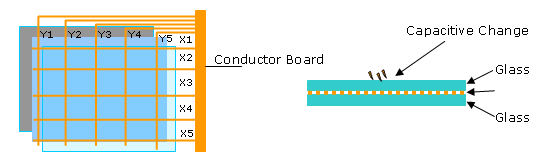

Projected Capacitive Touch (PCT) is an advanced touch technology that enables users to interact with devices through intuitive and responsive input. PCT screens consist of a series of sensors embedded within a glass overlay. These sensors detect the electrical properties of the human finger, allowing the touch screen to perceive the exact location of the touch and respond accordingly.
The projected capacitive touch screen works on the principle of conventional capacitive touch screens with the addition of two sensing arrays (X and Y) on two different layers that are perpendicular to each other along with a drive line. As X and Y arrays exist on different layers, the point where the two intercept becomes a capacitive node. When electrical currents run along one of the arrays through the drive line, the other array and the circuitry that detects change in capacitive values becomes connected. During actual operation, the controller sends electrical currents to the drive lines on different layers to create a specific electrical field with the nodes.
When the user places his finger or uses a touch medium close to the touch screen, the controller immediately picks up the change in capacitive value between the nodes and drive lines to pinpoint the exact location of the touch event. Since the sensing arrays on the panel form a 3D electrical field that is independent to the surface capacitors, the touch event registers even when no physical contact with the touch screen is made. In other words, projected capacitive touch screens feature Z-axis recognition.
Overall, PCT technology is an important advance in touch screen technology, with the potential to significantly enhance the functionality and usability of a wide range of devices. Whether you are using your smartphone or your tablet, PCT touch screens offer an intuitive and engaging way to interact with your digital world.